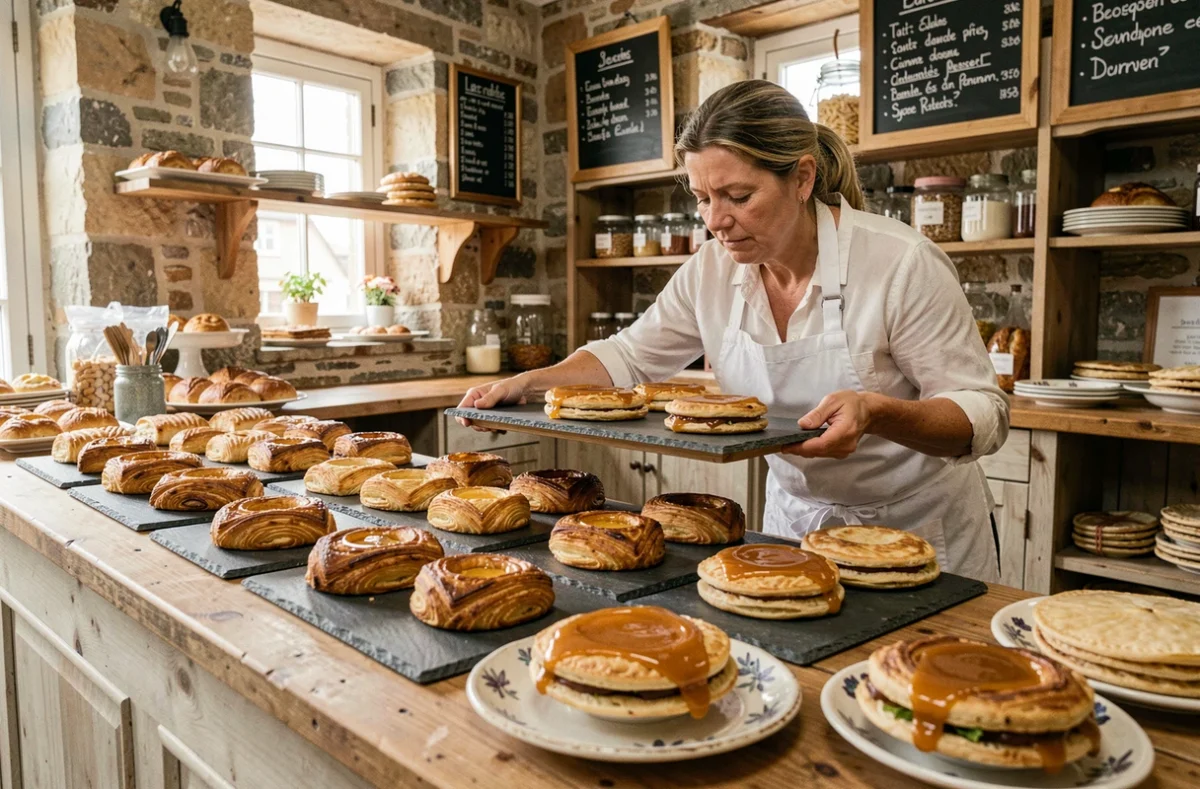
Half-salted butter, buckwheat flour, and farm-fresh eggs form the technical foundation of Breton pastry. Understanding what distinguishes a successful kouign-amann from an industrial version or spotting new artisanal signatures requires a sharper eye than the usual tourist lists. Here, we review the manufacturing criteria, the specialties to master, and the addresses that are renewing the genre.
Layering and caramelization: what separates a good kouign-amann from a mediocre one
The kouign-amann relies on a butter-sugar layering applied to bread dough. The difficulty lies in the number of folds: too few and the crumb remains dense, too many and the layering collapses during baking. The sugar, incorporated between the layers, must melt and caramelize in contact with the mold without burning.
A well-executed kouign-amann has a crunchy, almost brittle outer crust, while the heart remains soft and slightly elastic. The amber-brown color of the caramel on the surface is a reliable indicator of the mastery of oven temperature.
In Douarnenez, the historical cradle of this specialty, the Boulangerie des Plomarc’h perpetuates a manual shaping that favors a short layering process. We recommend tasting several approaches to grasp the extent of the technical spectrum.
If you are looking to explore the best pastries in Brittany beyond the kouign-amann, the panorama expands considerably towards less publicized but equally demanding recipes.
Far breton and gâteau breton: two doughs, two cooking logics
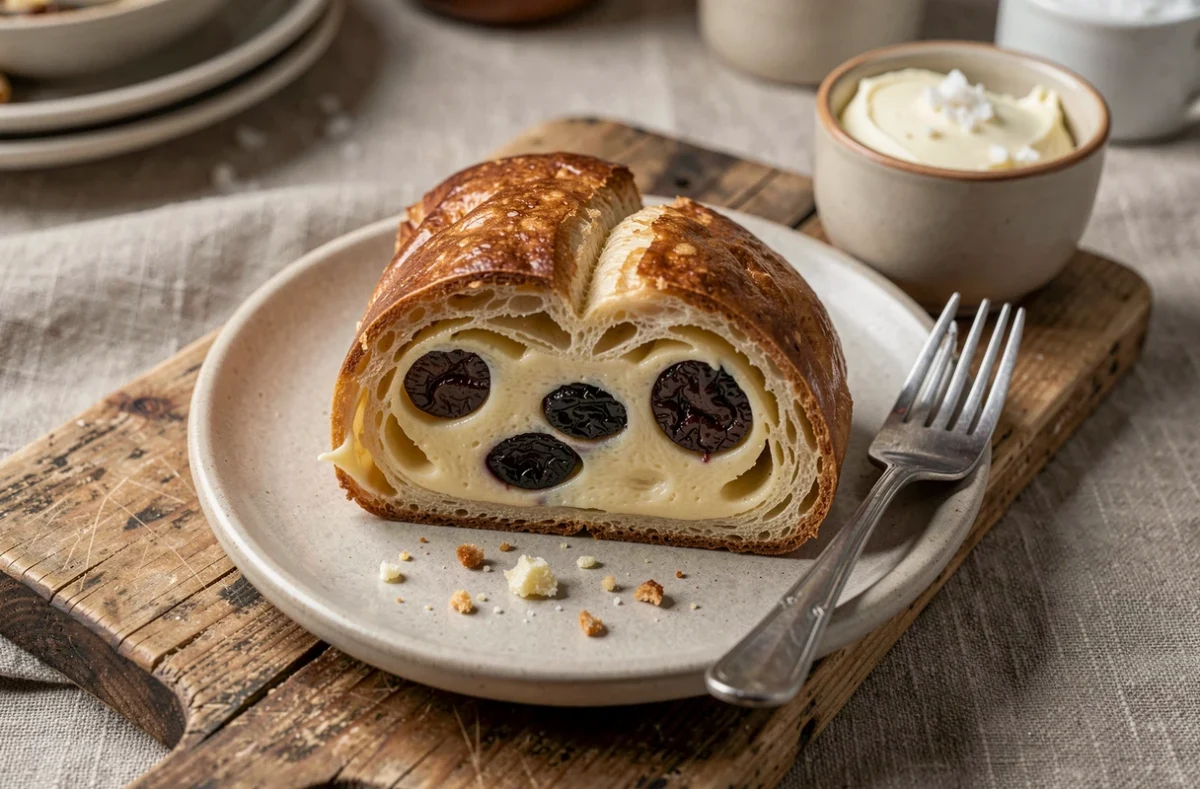
Far breton is a flan mixture enriched with eggs, traditionally baked in a clay dish. The version with prunes remains the most common, but the plain far without filling tests the quality of the mixture itself. A successful far offers a dense texture without being compact, with a slightly domed and golden surface.
The gâteau breton follows a different logic. Its very buttery shortcrust pastry, worked cold, yields a tight and crumbly crumb. The addition of egg yolks in quantity gives it that characteristic intense yellow color. The comb pattern drawn on the top before baking is not decorative: it allows the cake to bake evenly by creating heat grooves.
Criteria for evaluating these two classics
- The far must hold its shape when cut without collapsing, a sign that the flour-egg-milk ratio is mastered. A far that runs indicates an excess of milk or undercooking.
- The gâteau breton should crumble into large pieces, not powder. A texture that is too dry betrays insufficient quality butter or excessive kneading.
- The smell of cooked butter should dominate upon opening the package. If the vanilla aroma takes over, the recipe has likely been modified to compensate for standard butter.
Breton palets and salted butter cookies: the role of salt in the structure
Breton palets and shortbread cookies use half-salted butter, where the salt acts as a flavor enhancer and texture regulator. The salt slightly slows down gluten development, which keeps the cookie crumbly rather than rubbery.
The cooking of salted butter caramel, a central component of many Breton cookies and confections, is an exercise in thermal precision: a few degrees too many turn pleasant bitterness into a burnt taste.
We observe that cookie makers who display a supply of butter sourced from nearby farms produce more consistent results. Fresh, unfrozen butter behaves differently during layering and crumbling.
New generation Breton pastries: what’s changing in Rennes
The Breton pastry scene is no longer limited to heritage recipes. In Rennes, the shop Mordus, founded by Victoire Darcq and Matthieu Jolivel and opened on June 11, 2025, illustrates a shift towards daily homemade production with local and seasonal ingredients.
This model breaks away from the logic of centralized laboratories that supply multiple points of sale. Here, each piece is made on-site the same day, which imposes a limited volume but guarantees a freshness that long supply chains cannot offer.
Short circuits and ingredient traceability
Local sourcing is becoming a concrete differentiation criterion. A producers’ shop opened in Locminé in April 2025 brings together bread, flour, honey, and eggs from farms located within 35 km. This type of short circuit allows pastry chefs to know precisely the origin of each component.
For the informed consumer, the question to ask is no longer “which specialty to taste” but “where do the flour and butter come from.” A kouign-amann made with local churned butter and another made with industrial butter do not have the same aromatic profile, even if the recipe is identical.
Public support accompanies this transition. For example, Pontivy Communauté helped the bakery-pastry shop Aubery in Sourn with a grant of 7,500 euros under the Commerce and Craft Pass to modernize its production tool. This type of support fosters the maintenance of a dense artisanal fabric in the face of pressure from large retail chains.
Today, Breton pastry is viewed on two levels: the technical mastery of historical recipes and the ability of artisans to renew their offerings with traceable ingredients. Prioritizing addresses that produce on-site, with fresh butter and local flour, remains the most reliable criterion for distinguishing a true artisanal pastry shop from a storefront repainted in the colors of the region.